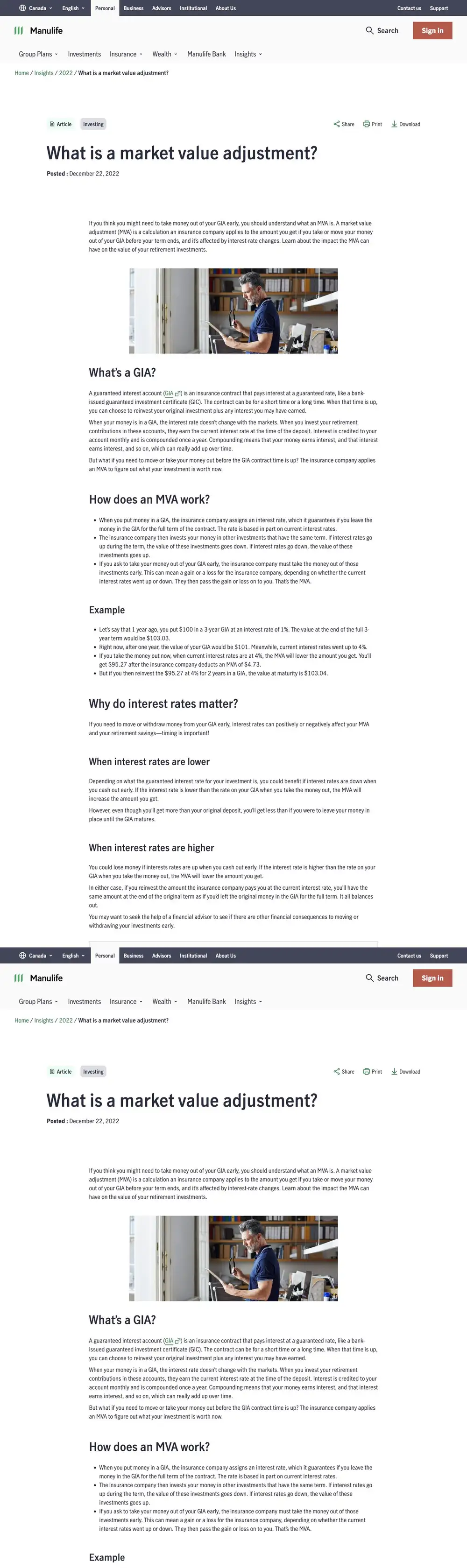
Observed result 1 · Canadian guaranteed-interest account explainer
Manulife
“If interest rates go up during the term, the value of these investments goes down.”
Its worked example also shows a higher current rate lowering the amount paid.
Annuity rate data from AdvisorWorld and CANNEX carrier feeds
Check the data date shown with any rate before you rely on it. View current rates
Working Papers · Forge AI™ from AdvisorWorld
See a custom 16-page look at annuity choices, modeled outcomes, and tradeoffs.
ChatGPT plugin is live. Research rates and products in your chat. Claude coming soon.
Free personalized report
Choose a goal to start your report. We’ll carry your answer into the next step.
Accuracy audit
We reviewed nine visible Google results. One prominent page states the core rates-up/rates-down effect backwards in one section, then contradicts itself elsewhere.
Search and pages accessed August 13, 2026
Technically reviewed byNikhil Bhauwala, CFAon August 14, 2026
In a clean Google search observed on August 13, 2026, Annuity.org ranked third, not first. Rankings vary by time, location, and personalization, so this audit records the observed order instead of asserting a universal rank. The page still contains the directional error described below.
Annuity.org's “How Does an MVA Work?” section says: If current rates are higher than when you bought the annuity, your withdrawal may receive a positive MVA, possibly increasing your payout.
That direction is backwards under the two standard formula shapes in the Insurance Compact standards and under the general relationship stated in the NAIC deferred-annuity buyer's guide. With the starting rate and all other inputs held constant, a higher current comparison rate lowers the formula result; a lower current comparison rate raises it.
Our good-faith posture is explicit: we're confident this is an editorial error, not intent. The evidence for that reading is on the page itself: its later FAQ gives the correct direction, while its worked example applies a negative sign after rates rise. The problem is internal inconsistency, not a theory about the publisher.
Captured from the live page on August 13, 2026. The image includes the page title, its stated update date, and the complete sentence.
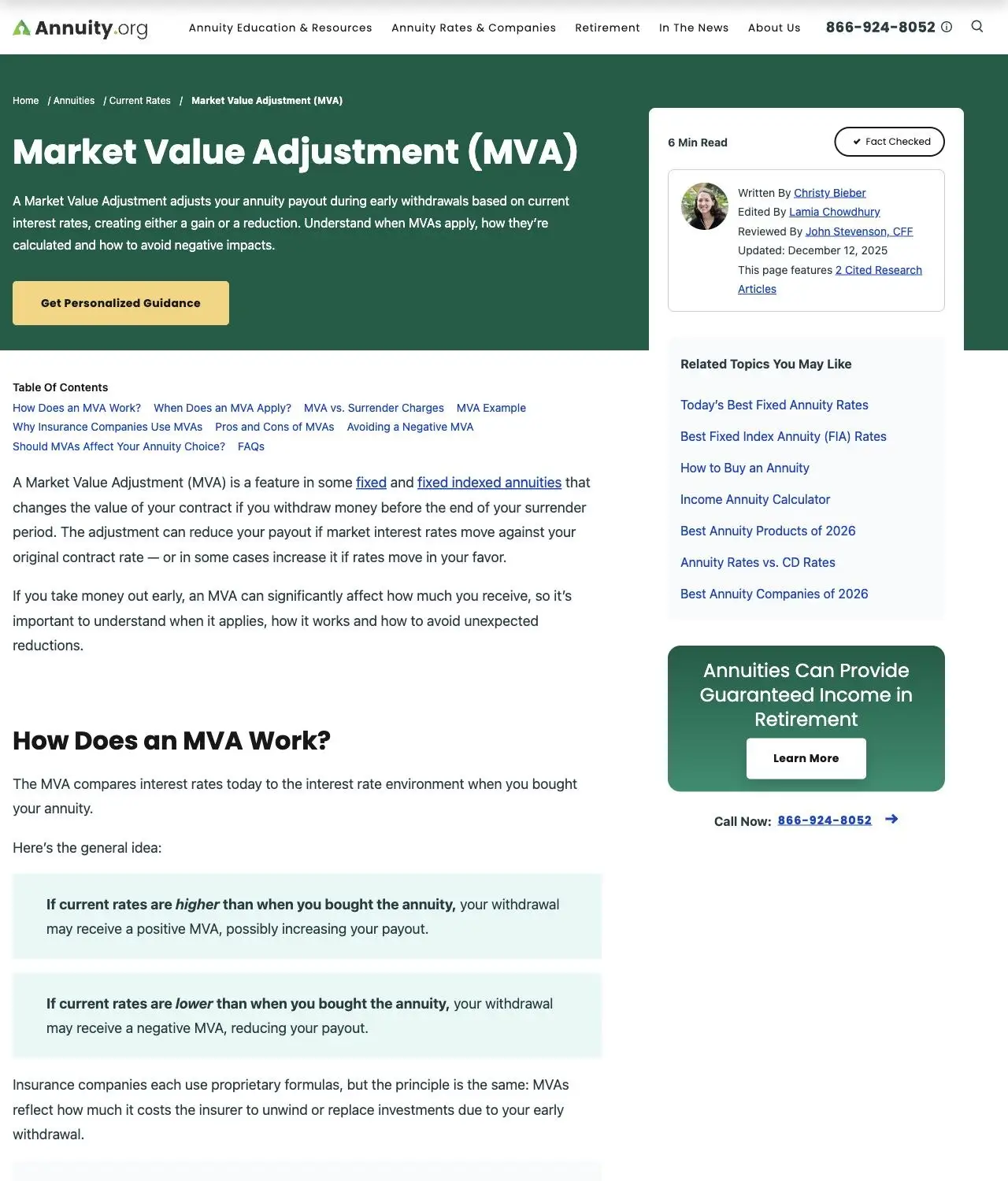
Query: market value adjustment annuity. Observed in a clean Google session on August 13, 2026. Quoted wording is evidence being audited, not a source for our MVA explanation. View the stitched top-to-bottom capture of that result page.
Observed result 1 · Canadian guaranteed-interest account explainer
“If interest rates go up during the term, the value of these investments goes down.”
Its worked example also shows a higher current rate lowering the amount paid.
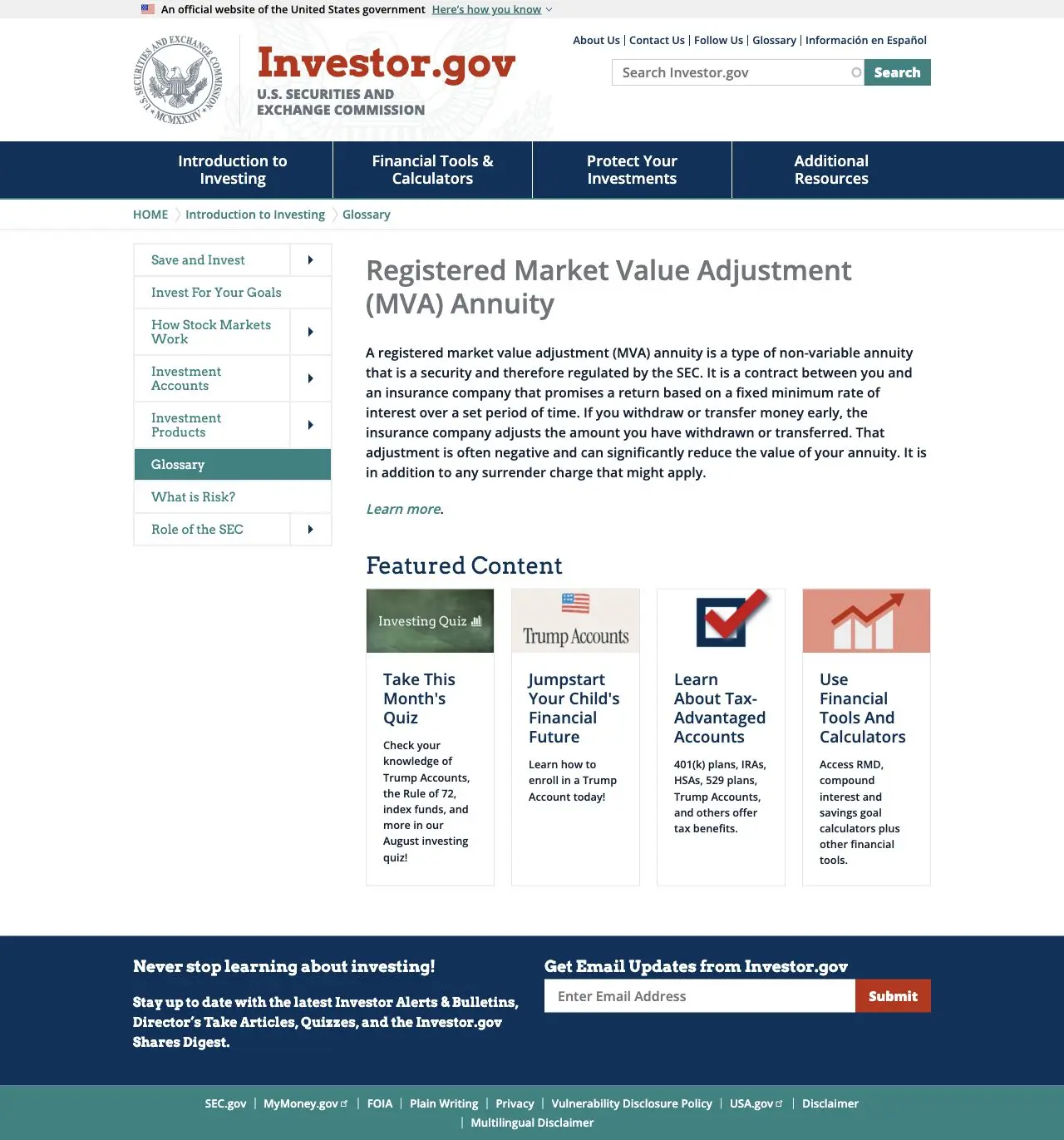
Observed result 2 · U.S. SEC investor glossary
“That adjustment is often negative and can significantly reduce the value of your annuity.”
It warns that an MVA may be negative but does not state the two rate directions.
Observed result 3 · U.S. consumer annuity explainer
“If current rates are higher than when you bought the annuity, your withdrawal may receive a positive MVA, possibly increasing your payout.”
The same page later gives the correct direction in its FAQ and a contrary sign in its numerical example, so the page is internally inconsistent.
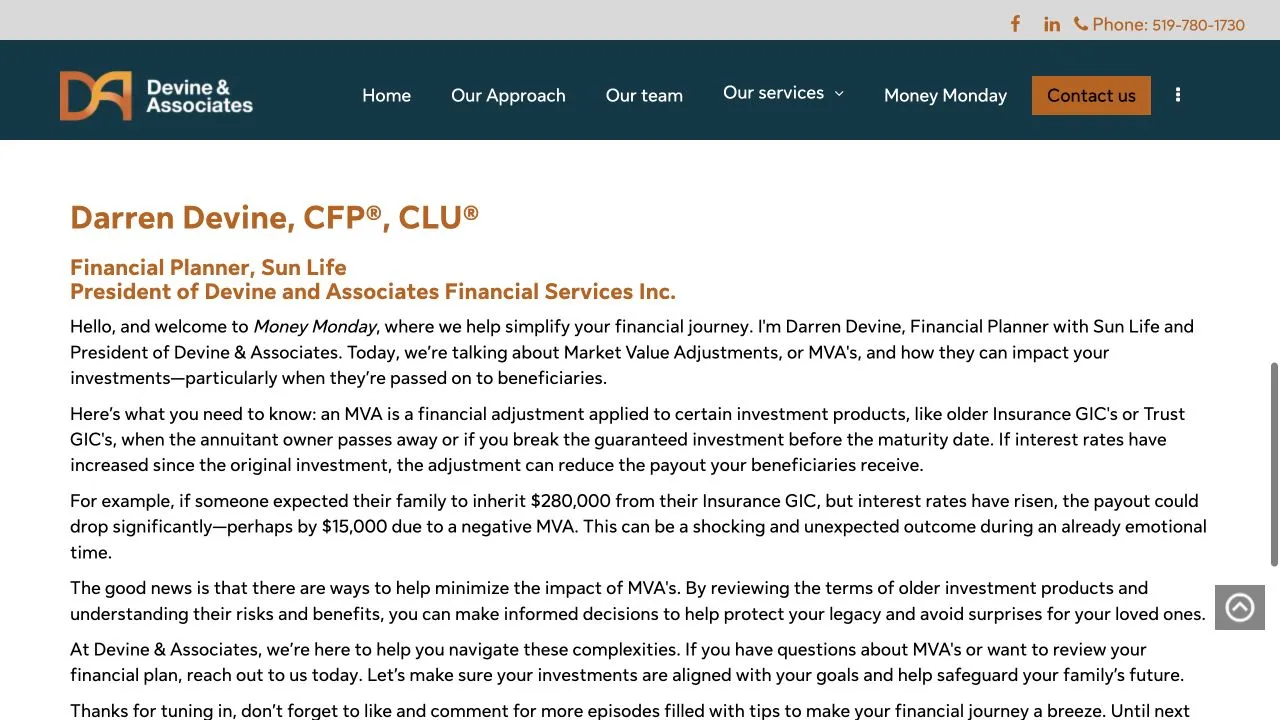
Observed result 4 · Canadian insurance GIC explainer
“If interest rates have increased since the original investment, the adjustment can reduce the payout …”
This result concerns Canadian insurance GICs rather than a U.S. deferred-annuity contract.
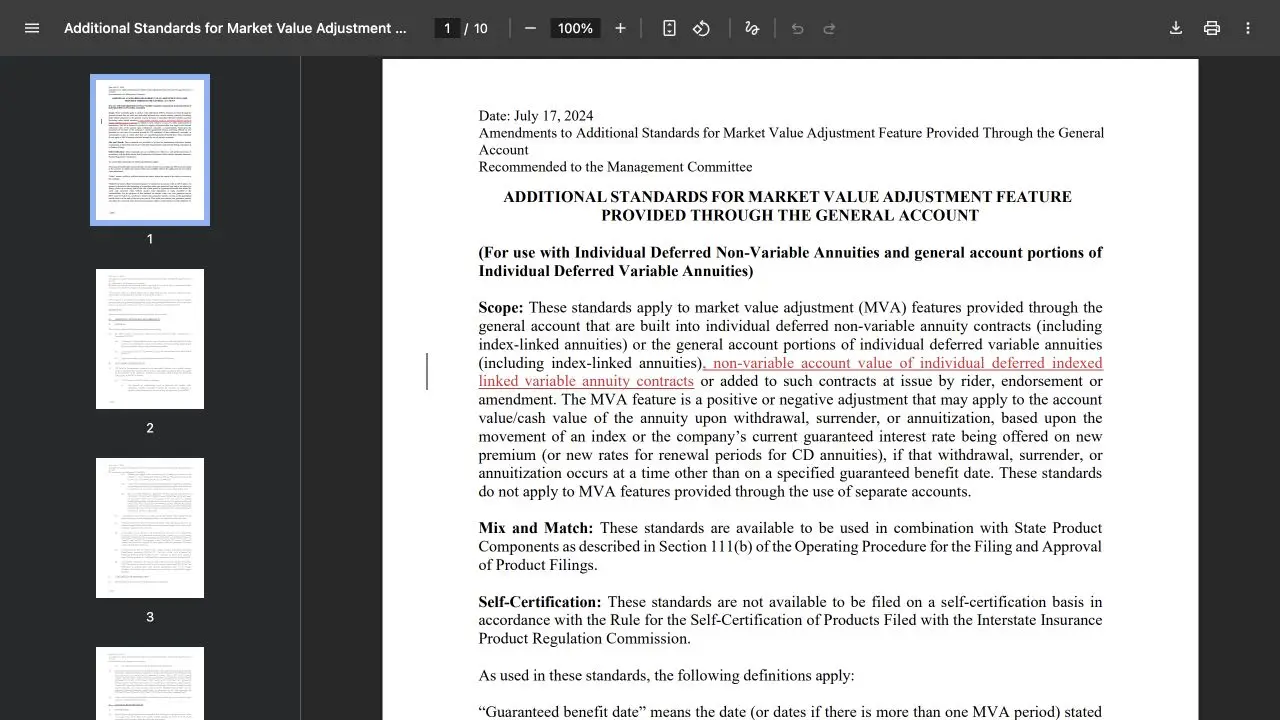
Observed result 5 · U.S. product-standard PDF
“The MVA feature is a positive or negative adjustment …”
Appendix A supplies both sample formula shapes used in our explainer.
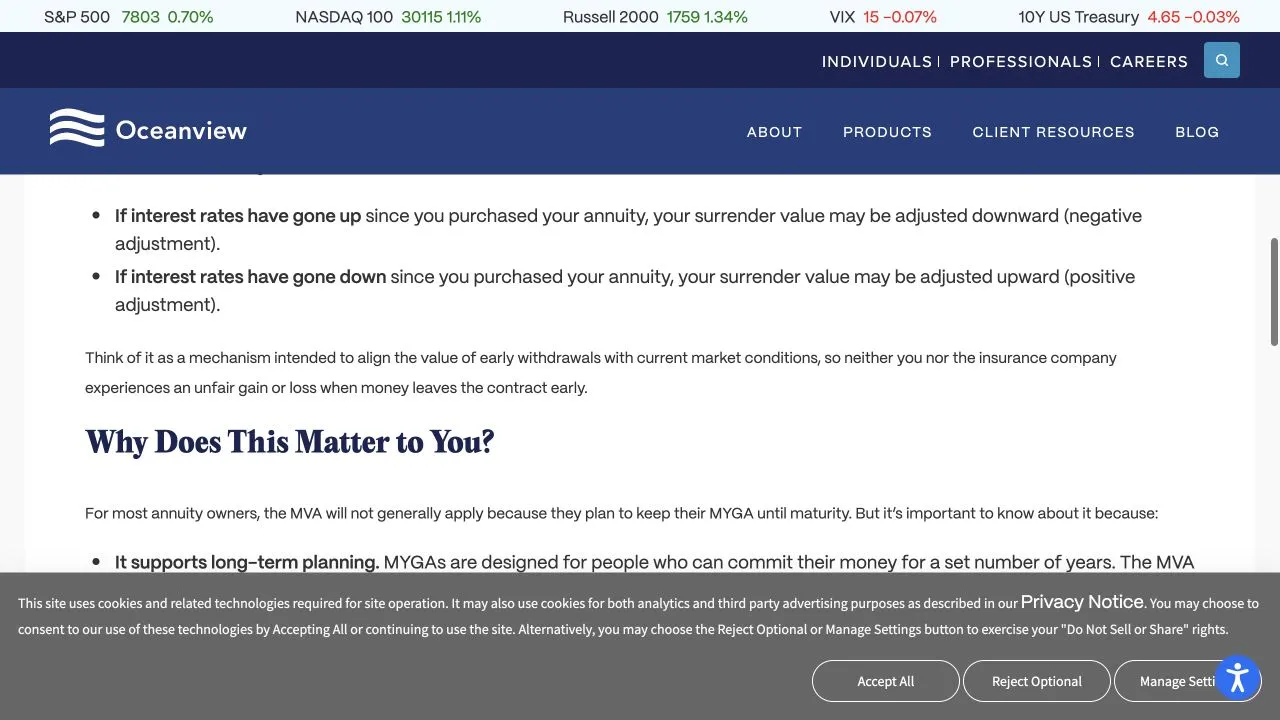
Observed result 6 · U.S. MYGA explainer
“If interest rates have gone up … your surrender value may be adjusted downward (negative adjustment).”
It also states the inverse case correctly for falling rates.
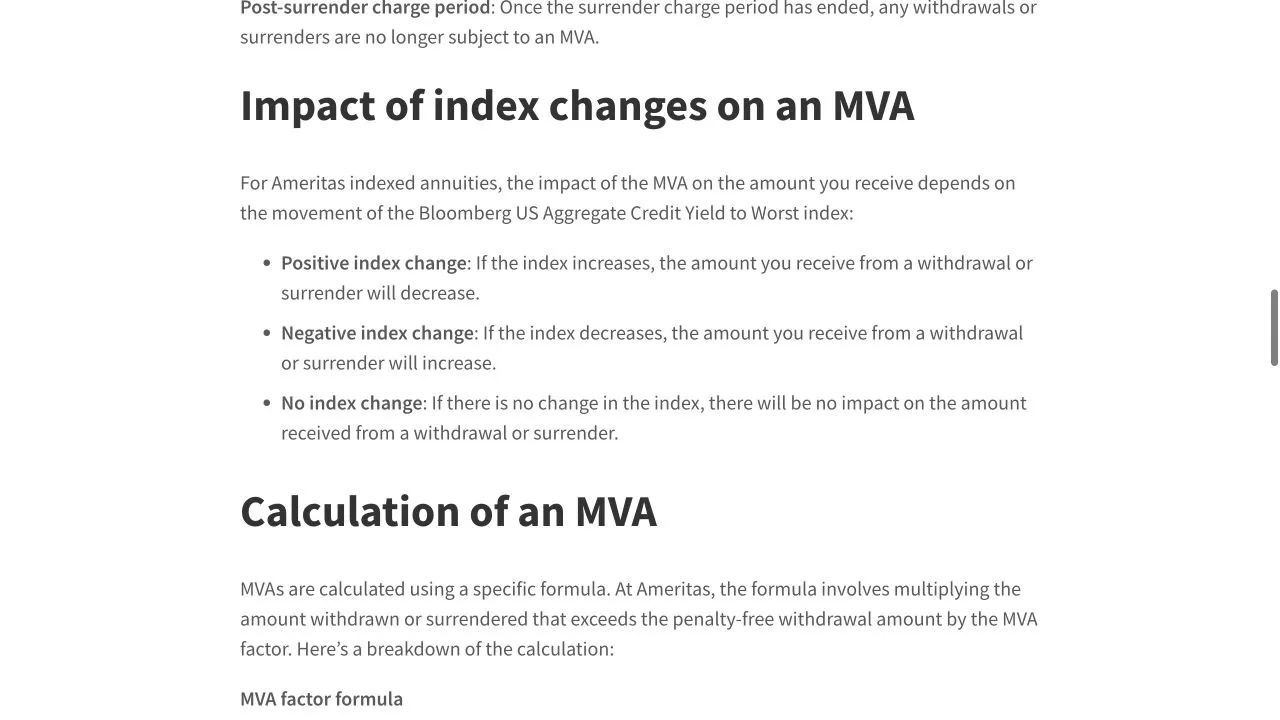
Observed result 7 · U.S. indexed-annuity explainer
“Positive index change … the amount you receive … will decrease.”
It names the Bloomberg U.S. Aggregate Credit Yield to Worst as the relevant index for the discussed contracts.
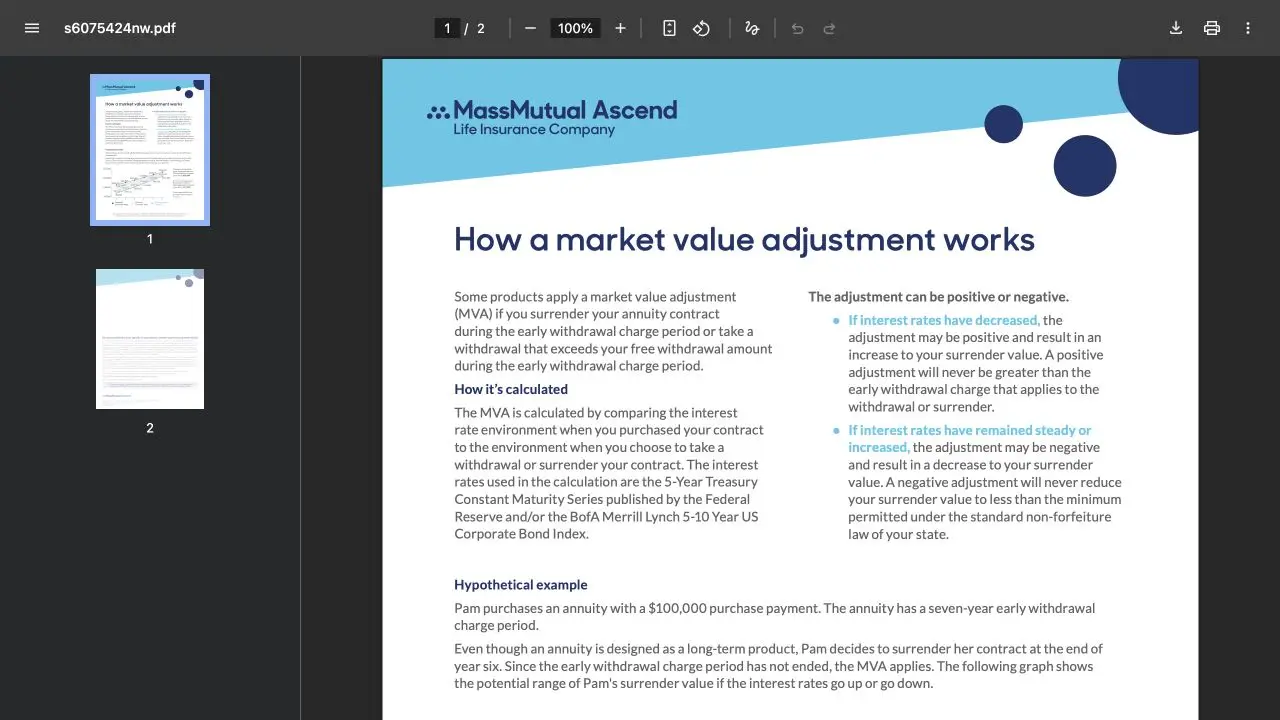
Observed result 8 · U.S. annuity explainer PDF
“If interest rates have decreased, the adjustment may be positive.”
It also discloses that its hypothetical limits and minimums can vary by state.
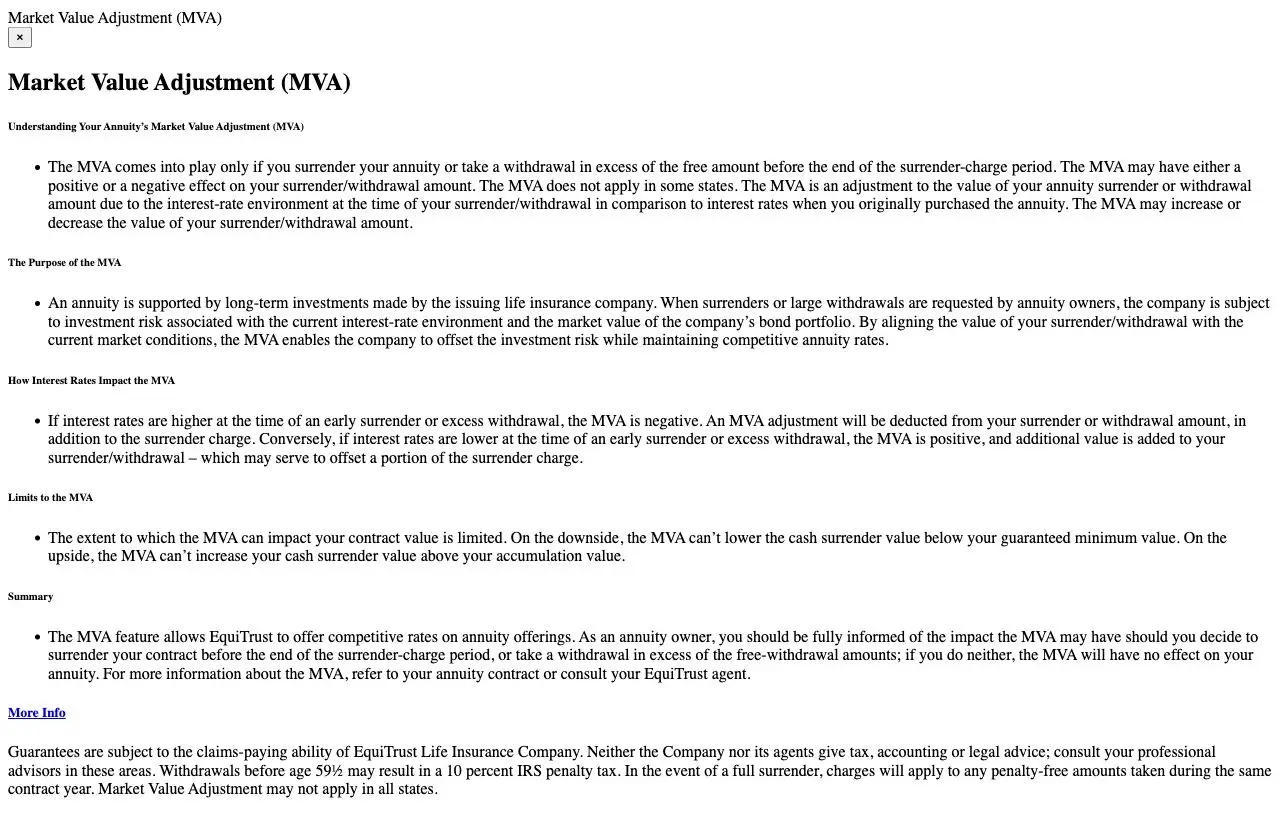
Observed result 9 · U.S. annuity explainer
“If interest rates are higher … the MVA is negative.”
It separately identifies the guaranteed minimum-value floor and accumulation-value ceiling.
The Annuity Edge's February 24, 2025 explainer is not in the nine-result set above, but it states the direction plainly: rates up, adjustment down; rates down, adjustment up. It also shows the ratio-power formula and identifies time remaining as a driver of magnitude. We credit that treatment because accuracy should be acknowledged regardless of publisher.
Read The Annuity Edge explanationWe recheck cited pages when this audit is materially updated. If Annuity.org corrects the sentence, this page should retain the original finding with its access date and add, visibly: Since our review, the article has been corrected.
The correction date and a new capture belong beside that update.
The companion explainer computes both regulator-accepted formula shapes, shows both rate directions, and lists the contract inputs that can change the outcome.
Market Value Adjustments: formulas and worked examplesFree personalized report
Choose a goal to start your report. We’ll carry your answer into the next step.